Galaxy Surveys
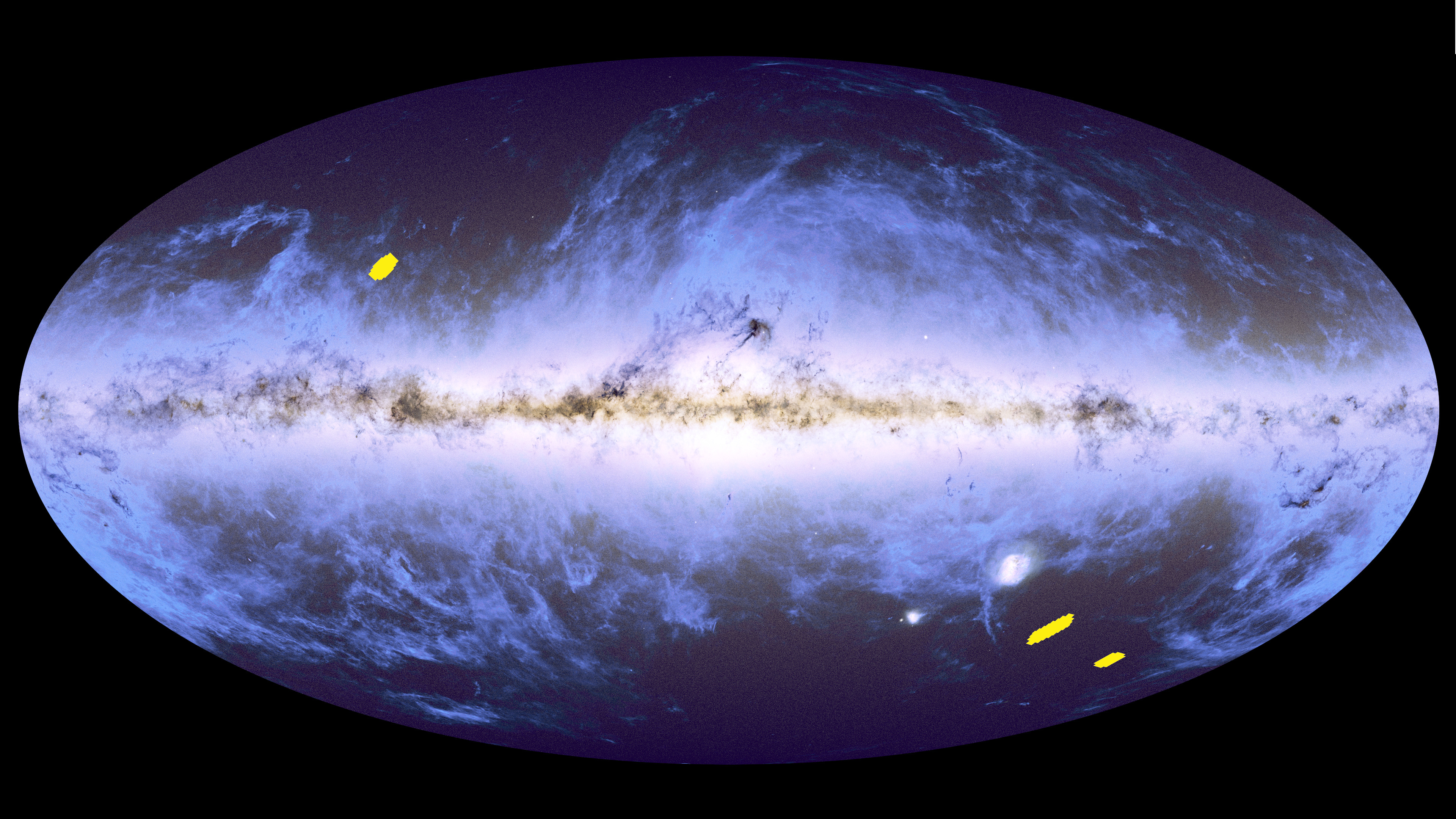
Today, galaxy surveys provide the foundation of precision cosmology. Measurements of galaxy clustering, BAOs, weak gravitational lensing and redshift-space distortions are used to investigate the nature of dark matter and dark energy, test gravity on cosmological scales, and study the formation and evolution of galaxies across cosmic time. Durham researchers play leading roles in several of the world's flagship spectroscopic, imaging and radio surveys. These surveys are also closely connected to Durham's internationally recognised strengths in cosmological simulations and theoretical modelling.
Currently we are involved in the following major surveys, which are either on-going or in the planning stages:
-
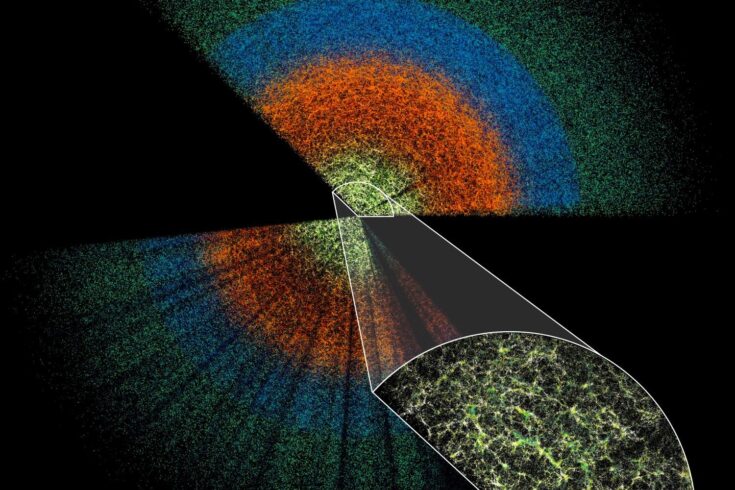 DESI (Dark Energy Spectroscopic Instrument) is producing the largest three-dimensional map of the Universe ever constructed. Durham is an institutional member of the DESI Collaboration and contributes to a wide range of cosmological and galaxy-evolution analyses using spectroscopic observations of tens of millions of galaxies and quasars. DESI completed its original five-year survey in 2026 with more than 47 million galaxy and quasar spectra and continues to extend its cosmological dataset.
- Euclid is ESA's flagship cosmology mission, launched in 2023, which is mapping billions of galaxies across more than a third of the sky using imaging, spectroscopy and weak gravitational lensing. Durham researchers contribute to both the scientific exploitation of the survey and the interpretation of its measurements using theoretical models and simulations.
- 4MOST (4-metre Multi-Object Spectroscopic Telescope) is a major spectroscopic survey facility on ESO's VISTA telescope. Durham is a consortium partner and is involved in several key survey programmes, including studies of galaxy evolution, large-scale structure, galaxy clusters, active galactic nuclei, and the Milky Way. Full survey operations began in 2026 and will ultimately provide spectra for more than 25 million objects across the southern sky.
- MOONS (Multi-Object Optical and Near-infrared Spectrograph) on ESO's Very Large Telescope will deliver transformational spectroscopic surveys of both distant galaxies and stellar populations in the Milky Way. Durham researchers are involved in the MOONS Guaranteed Time Observations programme and in the scientific exploitation of its surveys.
- The International LOFAR Telescope (ILT) is a world-class low frequency radio interferometer capable of sub-arcsecond imaging across a few degree field of view at MHz frequencies. Durham has contributed to a wide variety of scientific achievements with the ILT, including leading roles in LoTSS and upcoming LOFAR2.0 Large Programs like LUDO .
- HI surveys: Durham members are involved in state-of-the-art surveys using ASKAP (WALLABY ) and MeerKAT (MHONGOOSE & MIGHTEE-HI ), covering topics in AGN feedback, atomic gas kinematics, the baryon cycle and dark matter structure.
- The Square Kilometre Array Observatory will begin survey operations in 2029. Durham is one of the UK's sites for the SKA Regional Centres, providing leadership in accessing SKA data and generating scientific output.